






How Ohio compares to DUI/OVI penalties across America
A state-by-state look at impaired driving laws, financial costs, and how Ohio’s strict first-offense OVI penalties measure up against national standards.
Impaired driving laws vary drastically across the United States. While the federal government incentivizes certain baseline standards, individual states determine the specific fines, jail times, and license suspensions a driver faces after an arrest. In Ohio, operating a Vehicle Under the Influence (OVI) carries mandatory minimum penalties even for a first-time offense, placing the state among those with stringent impaired driving enforcement.
Key takeaways
- A first-time OVI conviction in Ohio carries a mandatory minimum of 3 days in jail, with potential sentences of up to 6 months.
- The true financial cost of a first-time impaired driving offense can easily exceed $10,000 when factoring in court fees, insurance hikes, and legal costs.
- Thirty states and Washington, D.C. mandate Ignition Interlock Devices (IIDs) for all impaired-driving offenders, while other states base requirements on BAC levels or judicial discretion.
- While 49 states and D.C. maintain a 0.08% legal Blood Alcohol Concentration (BAC) limit, Utah operates under a stricter 0.05% threshold.
Click to view the full-size infographic
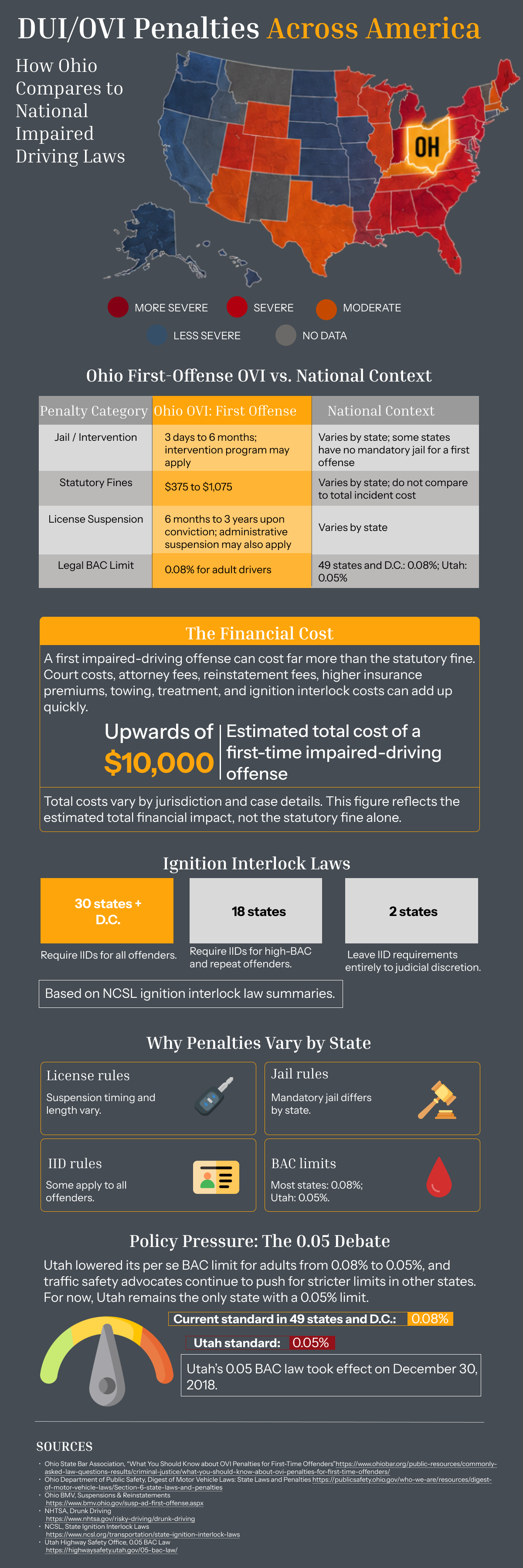
Ohio first-offense OVI penalties vs. the national landscape
In many states, a first-time DUI may result in probation without mandatory jail time, but Ohio law takes a stricter approach. A first-offense OVI in Ohio requires a mandatory minimum of three days in jail (or an approved driver intervention program) and can result in up to six months of incarceration. Statutory fines for a first offense in Ohio range from $375 to $1,075. Additionally, a conviction triggers a mandatory driver’s license suspension ranging from six months to three years. This does not include the immediate administrative suspension that occurs if a driver fails or refuses a chemical test at the time of arrest.
Because impaired driving statutes are left to individual states, the national context varies widely. Suspension lengths, fines, and jail terms vary significantly depending on the jurisdiction in which the offense occurs.
The true financial cost of a conviction
Statutory fines represent only a fraction of the total financial burden an impaired driving conviction creates. The National Highway Traffic Safety Administration (NHTSA) estimates that a first-time offense can cost upwards of $10,000.
This $10,000 estimate accounts for the compounding expenses that follow an arrest. Beyond the initial $375 to $1,075 court fine in Ohio, individuals must pay for vehicle towing, impound fees, court costs, and mandatory substance abuse treatment programs. Once a license is suspended, the driver faces reinstatement fees and the cost of installing and maintaining an Ignition Interlock Device. Furthermore, a conviction generally categorizes an individual as a high-risk driver, leading to severely elevated auto insurance premiums for years following the incident.
Ignition interlock laws across the U.S.
Ignition Interlock Devices (IIDs), breathalyzers installed in a vehicle that prevent the engine from starting if alcohol is detected, are becoming a standard penalty nationwide. However, the application of these laws depends heavily on the state.
Currently, 30 states and Washington, D.C. require IIDs for all impaired driving offenders, regardless of whether it is a first offense or the driver’s specific BAC level. Another 18 states require IIDs conditionally, typically targeting high-BAC offenders or repeat offenders. Only two states leave IID implementation entirely to the presiding judge’s discretion.
The national BAC debate: 0.08% vs. 0.05%
For decades, the standard legal limit for adult drivers across the country has been a Blood Alcohol Concentration of 0.08%. Currently, 49 states and Washington, D.C. maintain this 0.08% threshold.
However, policy pressures are beginning to shift this standard. On December 30, 2018, Utah became the first and only state to lower its per se adult BAC limit to 0.05%. While traffic safety advocates continue to push for this stricter 0.05% standard nationwide, the 0.08% limit remains the law in Ohio and the vast majority of the country.
Evolving enforcement frameworks and local impacts
The national data highlights that impaired driving enforcement is a rapidly changing landscape, marked by a growing reliance on mandatory technological interventions like ignition interlocks and discussions surrounding lower BAC thresholds. Because individual states retain complete autonomy over sentencing frameworks, drivers face vastly different penal realities depending on which state they cross. In states like Ohio, where mandatory minimum jail times and multi-year license suspensions apply to even first-time offenders, navigating the local court system requires a highly precise understanding of state-level statutory requirements.
Methodology
Data regarding Ohio’s specific OVI penalties, including fines, jail time, and license suspensions, is sourced from the Ohio State Bar Association, the Ohio Department of Public Safety, and the Ohio Bureau of Motor Vehicles. Financial impact estimates and national baseline standards are provided by the National Highway Traffic Safety Administration (NHTSA). State-by-state comparisons of Ignition Interlock Device (IID) laws are based on data compiled by the National Conference of State Legislatures (NCSL). Utah’s BAC limit data is sourced directly from the Utah Highway Safety Office.
Frequently asked questions
What is the difference between a DUI and an OVI in Ohio?
In Ohio, the legal term for impaired driving is Operating a Vehicle Under the Influence (OVI). While many people and other states use the term DUI (Driving Under the Influence), OVI is the official statutory charge in Ohio. The penalties and legal processes are essentially the same as those traditionally associated with a DUI.
Will I go to jail for a first-time OVI in Ohio?
Yes, Ohio law mandates minimum penalties for a first-time OVI conviction. A judge must impose a minimum of three days in jail, though this requirement may sometimes be satisfied by completing an approved 72-hour driver intervention program.
How much does a first-offense OVI really cost?
While the statutory fine for a first-offense OVI in Ohio ranges from $375 to $1,075, the true cost is much higher. Factoring in court costs, attorney fees, license reinstatement, mandatory treatment classes, and increased insurance premiums, a first-time offense can cost an estimated $10,000 https://www.nhtsa.gov/risky-driving/drunk-driving.
Sources
- Ohio State Bar Association, “What You Should Know about OVI Penalties for First-Time Offenders”: https://www.ohiobar.org/public-resources/commonly-asked-law-questions-results/criminal-justice/what-you-should-know-about-ovi-penalties-for-first-time-offenders/
- Ohio Department of Public Safety, Digest of Motor Vehicle Laws: https://publicsafety.ohio.gov/who-we-are/resources/digest-of-motor-vehicle-laws/Section-6-state-laws-and-penalties
- Ohio BMV, Suspensions & Reinstatements: https://www.bmv.ohio.gov/susp-ad-first-offense.aspx
- NHTSA, Drunk Driving: https://www.nhtsa.gov/risky-driving/drunk-driving
- NCSL, State Ignition Interlock Laws: https://www.ncsl.org/transportation/state-ignition-interlock-laws
- Utah Highway Safety Office, 0.05 BAC Law: https://highwaysafety.utah.gov/05-bac-law/
Use the following embed code to post this infographic on your website:
